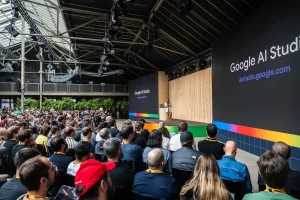
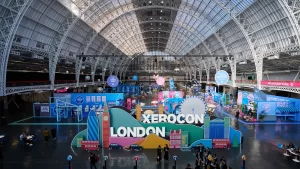
Your conference happens once. There is no reshoot, no second take, no “we’ll fix it next time”. Which makes choosing the photographer one of the few event decisions with zero margin for error.
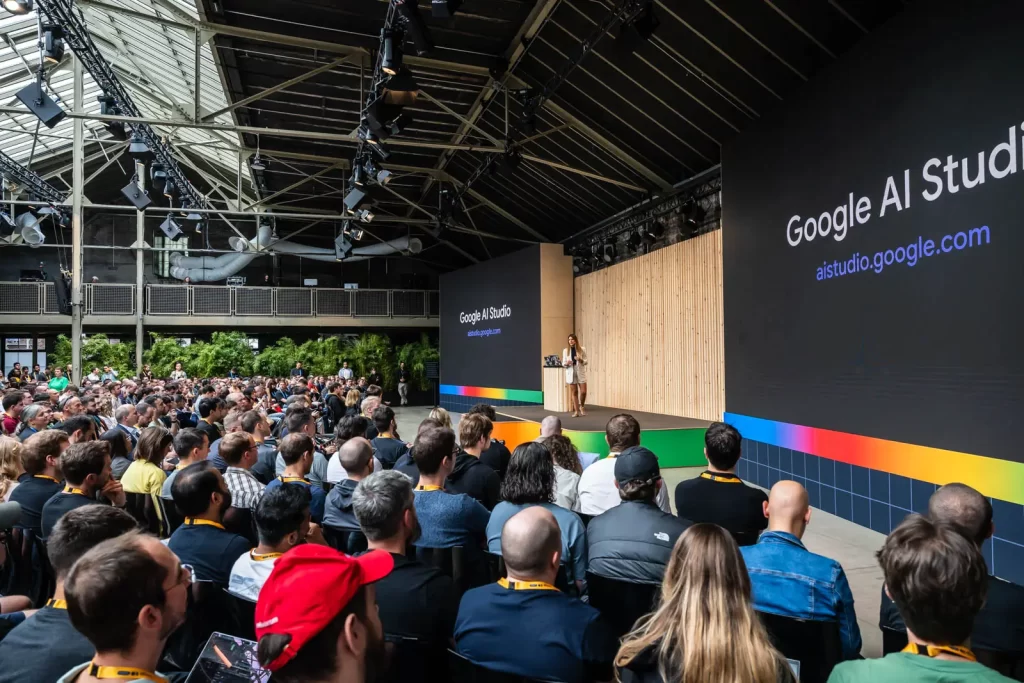
Main Stage of Google IO in Berlin – 2 days coverage for Google.
I’ve photographed corporate events in London for over 25 years — for clients including Google, Adobe, Stripe, Xero and Canva Education — and I’ve heard every story about the photographer who didn’t work out. Almost all of those stories could have been prevented by asking the right questions before booking.
Here are the ten that matter.
1. “Can I see full galleries from real corporate events — not just highlights?”
Anyone can curate 20 great shots from a decade of work. What you need to see is consistency: a complete gallery from a single event, showing how they handle the dull-but-essential coverage — sponsor branding, wide room shots, delegates networking — alongside the hero moments. A professional will share full galleries without hesitation.
2. “Have you worked at my venue before?”
Not a dealbreaker, but a genuine advantage. London venues each have their own lighting challenges: the mixed daylight of the Barbican’s conservatory level, the vast halls of ExCeL, the ornate low light of Guildhall. A photographer who has worked at your venue — or a comparable one — already knows where the problems are. I regularly shoot at ExCeL, Olympia, the Barbican, Guildhall, the Science Museum and the Natural History Museum, among others.
3. “What exactly is included in the price?”
Get it in writing: hours on site, number of edited images, turnaround time, and usage rights. A quote that just says “full-day coverage: £X” tells you almost nothing. For context on what fair London pricing looks like, see my [corporate event photography pricing guide]
4. “What usage rights do I get?”
This is where inexperienced buyers get caught. Some photographers licence images for limited use and charge again when you want them in a press release or an ad campaign. For corporate work, you should receive full commercial usage rights across all your business communications — website, social, press, internal, marketing — with no expiry. That’s what I provide as standard.
5. “How quickly will we receive the edited images?”
Momentum matters. Event content performs best on LinkedIn within days, not weeks. My standard delivery is a fully edited, curated gallery within 5 working days. Anything beyond two weeks should raise questions. If you need same-evening images for social or press, ask whether that’s available as an add-on — and agree it before the event.
6. “What happens if your camera fails? Or if you’re ill?”
Professionals carry duplicate camera bodies, lenses, batteries and memory cards, and shoot to dual cards so no image exists in only one place. They also have a network of trusted colleagues who can step in should the worst happen. If a photographer hasn’t got a clear answer to this question, keep looking.
7. “How do you work a room?”
Corporate events are live business environments. The photographer needs to be invisible when senior people are mid-conversation and assertive enough to organise a board group shot in ninety seconds. My background is in press photography — the entire discipline is capturing real moments quickly, without staging and without getting in the way. Ask any photographer how they’d handle photographing your CEO’s keynote without becoming part of the show.
8. “Are you insured?”
Public liability insurance is non-negotiable — most major London venues require proof of it before allowing a photographer on site. Professional indemnity is a further sign you’re dealing with a genuine business.
9. “Who is actually turning up on the day?”
With agencies, the portfolio you’re shown and the photographer who arrives can be different people. When you book a dedicated specialist, the person whose work you assessed is the person who shoots your event. Make sure you know which arrangement you’re buying.
10. “Can we have a call before the event?”
The pre-event conversation is where good coverage is made: the running order, the VIPs who must be photographed, the sponsor obligations, the moments that matter to your stakeholders. A photographer who wants to just “turn up and shoot” is planning to guess. I run through a short brief with every client before the day — it takes fifteen minutes and it’s the cheapest insurance you’ll ever buy.
Red flags worth acting on
– No full galleries available on request
– Vague or missing usage rights
– No mention of backup equipment
– Prices dramatically below the London market (see [what corporate event photography costs in London] *(link to pricing article)*)
– Slow, inconsistent communication before booking — it won’t improve after payment
The short version
Hire on evidence, not price: full galleries, clear terms, fast turnaround, proper insurance, and a photographer who asks intelligent questions about your event before quoting. Get those five right and the photography will be the easiest part of your event to sign off.
Frequently asked questions
How far in advance should I book a corporate event photographer in London?
For peak season (September–December and March–June), 4–8 weeks ahead is sensible. Good photographers book out early for conference season, though last-minute availability does happen — it’s always worth asking.
Should I hire a freelance photographer or an agency for a corporate event?
A dedicated specialist gives you certainty: the portfolio you assessed is the person who turns up. Agencies offer scale for very large multi-photographer events but you rarely know who you’ll get. For most London corporate events, a single experienced specialist is the stronger choice.
What should I send a corporate event photographer before the event?
The running order, venue details, a list of key people to photograph, any sponsor branding requirements, and examples of how you plan to use the images. A 15-minute call covers the rest.
Looking for a corporate event photographer in London? [[See my corporate event photography and get a quote →]